Family Patterns · Mechanism
How essence and craft actually transmit.
The schema's core claim is that essence runs cross-sex and craft runs same-sex. That is right. But how the two transmit is asymmetric — passive versus constructed — and the essence channel itself runs in two phases. This asymmetry is where the strife pattern does its damage.
Two channels
The two lines are not just carrying different content — they are carrying it in different ways.
Cross-sex channel
Passive transmission of essence
Wavelength, temperament, affinity, the "same-frequency" bond. Runs automatically. The mother does not have to teach it, the maternal grandfather does not have to be present, alive, or even remembered directly. The tuning is set in the child's constitution and shows up regardless of intent.
The mother is the carrier. Her mere presence, plus her account of her father, is enough for the essence to reach the child.
Same-sex channel
Constructed transmission of craft
Trade, discipline, family style, how we do it. The specific values and habits by which this line operates in the world. Does not run automatically. Requires the same-sex parent to be actively present, to model, to correct, to teach — in effect, to build the transmission as an artwork over the child's whole upbringing.
If the father is absent, incompetent, indifferent, or in strife with the wider family, the artwork simply doesn't get built.
Consequences of the split:
- Essence can survive absence and even hostility of the source; craft cannot.
- Essence is what the child is; craft is what the child was taught.
- When the two conflict in a person, the essence wins the identity fight — because it was there first, unlearned, foundational.
Two phases of the essence channel
The cross-sex essence transmission is not one event at birth. It is two.
Phase 1 — birth-set essence. The wavelength is present in the child's constitution from the start. It varies in degree across families and across children within a family. Not every cross-sex chain is strong; some are faint. This is what the schema has always described.
Phase 2 — post-birth developmental engagement. The birth-set essence is a seed. It becomes an identity only through years of unencumbered engagement with the grandparent-figure — in person if the grandparent is living, or in family legend, photograph, story, and the mother's own tuning-and-testimony if the grandparent is dead or distant. Phase 2 is the water and light. Without it the seed stays a seed. With it the child grows into their nature — and, ideally, into an improved iteration of the grandparent, informed by the mother, the child's own era, and the child's own circumstances. Not a copy. The grandfather is the seed and the mirror; the grandchild is the next version.
Both phases matter, and Phase 2 is where the strife pattern does its damage.
What Phase 2 produces when unencumbered
The child sees themselves in a future-self mirror. They develop identity as legitimately-owned nature, not as a role adopted from outside. Enjoyment. Feet on the ground. Recognisable and continuous character across a life.
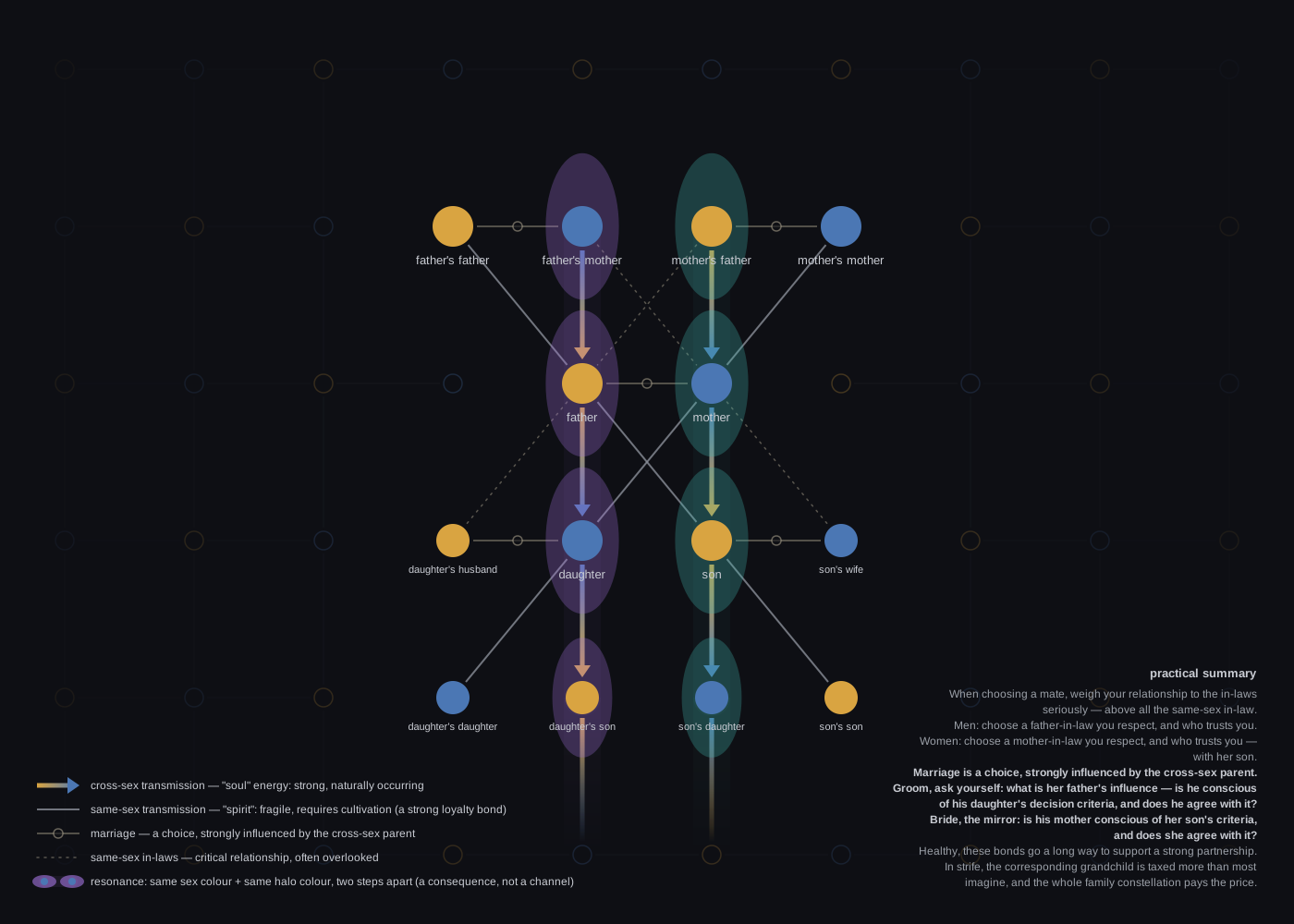
Harmony. Both channels conducting. Phase 2 running unencumbered for the grandson (right column) and granddaughter (left column). The halos mark the grandparent–grandchild resonance turning into an identity the child can live from.
What Phase 2 produces when blocked
"Frustrated" is too mild. What actually happens under a serious block is deeper and installs unconscious damage that surfaces later, often disastrously. The mechanism, spelled out:
- The parent on the block-line hates or resents the disliked grandparent-side essence. Usually the father, for grandsons. Often dated to before the child was born.
- The parent — often not consciously — punishes, ridicules, or repeatedly negates any child behaviour that "smells of" the grandparent's essence. This is the specific engine. Small corrections, mocking imitations, cold silences, lectures, beatings. Over years these small negations accumulate.
- The child, wired to attach to the parent, cannot afford to experience the punished behaviours as legitimately theirs. Over time these behaviours become experientially not-me.
- But they are the child's essence — the passively transmitted Phase 1 material. The child cannot delete them; they can only bury them.
- A structural denial of a piece of the self is installed, unconsciously, by roughly age six to ten. The child does not know consciously that anything is wrong. There is no framework yet to name what has been buried; the child only knows that certain behaviours produce disapproval, so those behaviours stop being available to consciousness.
- This is the specific setup for the personality-organisation disturbances the schema has always gestured at. No solid self, chronic performance, playing to someone else's tune, disproportionate fragility about identity and recognition. In clinical vocabulary this borders on narcissism, borderline, or false-self organisation, depending on the shape of the block and the child's other supports.
- Puberty and independence break the parent's active real-time repression. The buried piece begins to demand acknowledgement. What surfaces is not gentle rediscovery; it is often violent, disorienting, and directed at the living parent — who is now the only reachable target of a grievance the child cannot yet name.
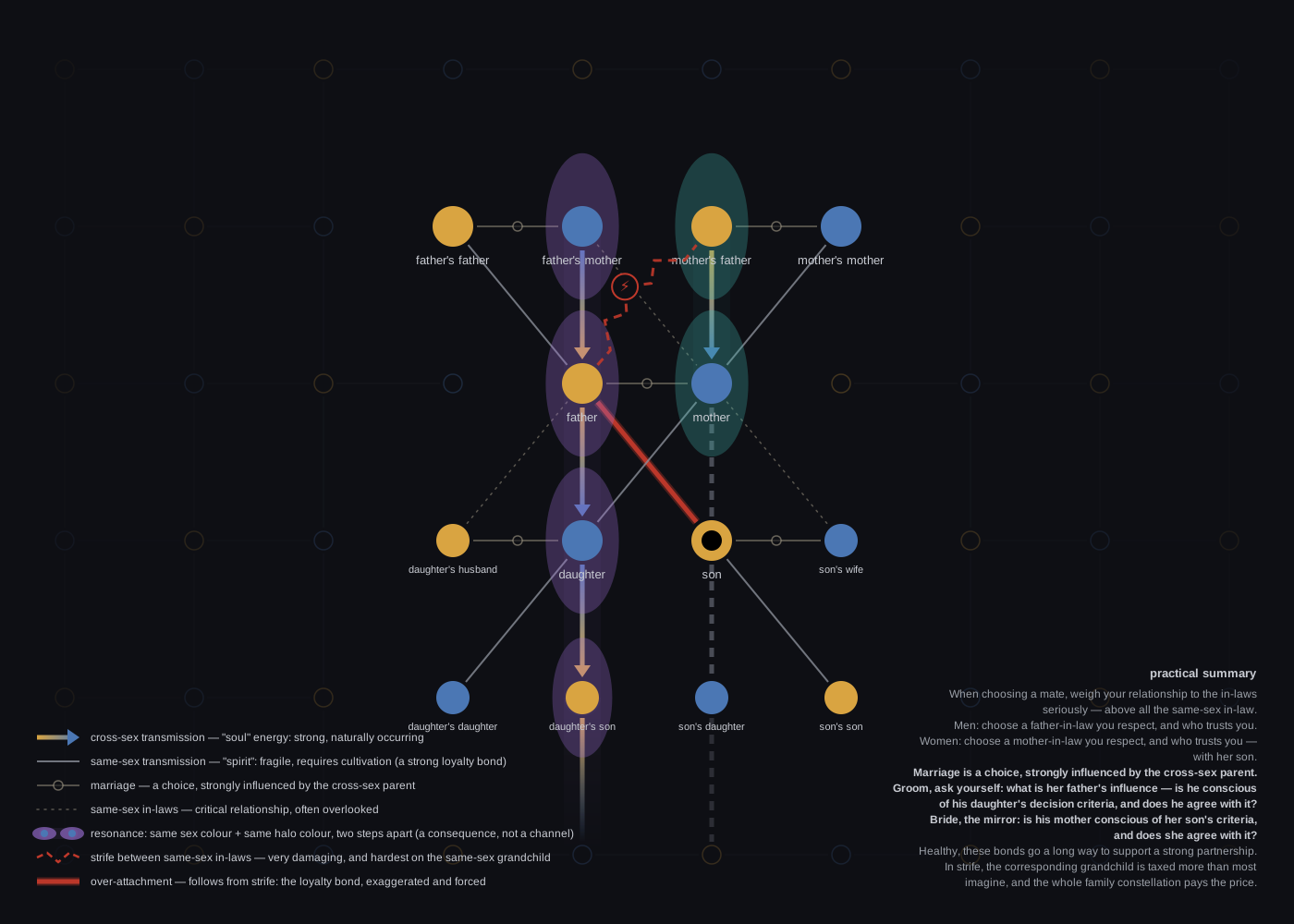
Strife. Father and maternal grandfather at war. The mother-to-son segment goes dark and dashed — the path is present but not conducting. The son loses his halo; a dark inner core takes its place. The block propagates downstream.
The rupture is thus a late accounting for a Phase 2 block the child was never able to see at the time. This is why the rupture pattern is dated to puberty or leaving home — it is the first moment the child has agency enough to do the Phase 2 work for themselves, and the buried material demands its due immediately and without diplomacy.
Reading rules
- The essence can survive absence, distance, and even the grandparent's death before the grandchild's memory — provided the mother holds Phase 2 open through legend and her own tuning. The Elon Musk case is the paradigm.
- Same-sex craft cannot survive absence or hostility of the source in the same way, because it has to be actively built. A hostile-and-present father can still transmit substantial craft (engineering, marriage patterns, interpersonal register) while an absent-and-loved father transmits almost none.
- Cross-sex line is given, same-sex line is built. Both can succeed, both can fail, and the failure modes are different — the cross-sex line fails as unconscious denial of self; the same-sex line fails as undelivered craft.
- The strife pattern is not about arbitrary hatred surfacing at puberty. It is the specific after-effect of a specific Phase 2 blockage, running on a specific mechanism (parental repression of grandparent-resembling behaviours in the child), producing a specific kind of damage.