Project · Living catalog
Family Patterns.
An observational schema for how emotional inheritance seems to travel — across sex, skipping a generation, along what turns out to be the same path as X-linked inheritance. Two diagrams show the shape at rest and what happens when it is blocked. A parallel machine-reading of period biography tests whether the shape shows up in the record.
Working catalog, not a scientific claim. Live document — will be updated as the observations and the scan accumulate.
The shape
The rule that holds the catalog together is simple. The traits that matter here — emotional disposition, aptitude, "wavelength" — do not run mother-to-daughter or father-to-son as the primary resemblance line. They run across sex. Mother to son. Father to daughter. And, when the same rule steps once more, the strongest affinity lands on the grandparent of the same sex as the child, reached through the cross-sex parent: maternal grandfather for a boy, paternal grandmother for a girl. The crossing is at the parent generation, not the grandparent generation.
The path has a name in this project — the criss-cross line — because it traces exactly the route an X-chromosome takes down a family tree. Whether the X-linked genetics is the mechanism or a coincidence is a question for another day. The shape is what is being catalogued.
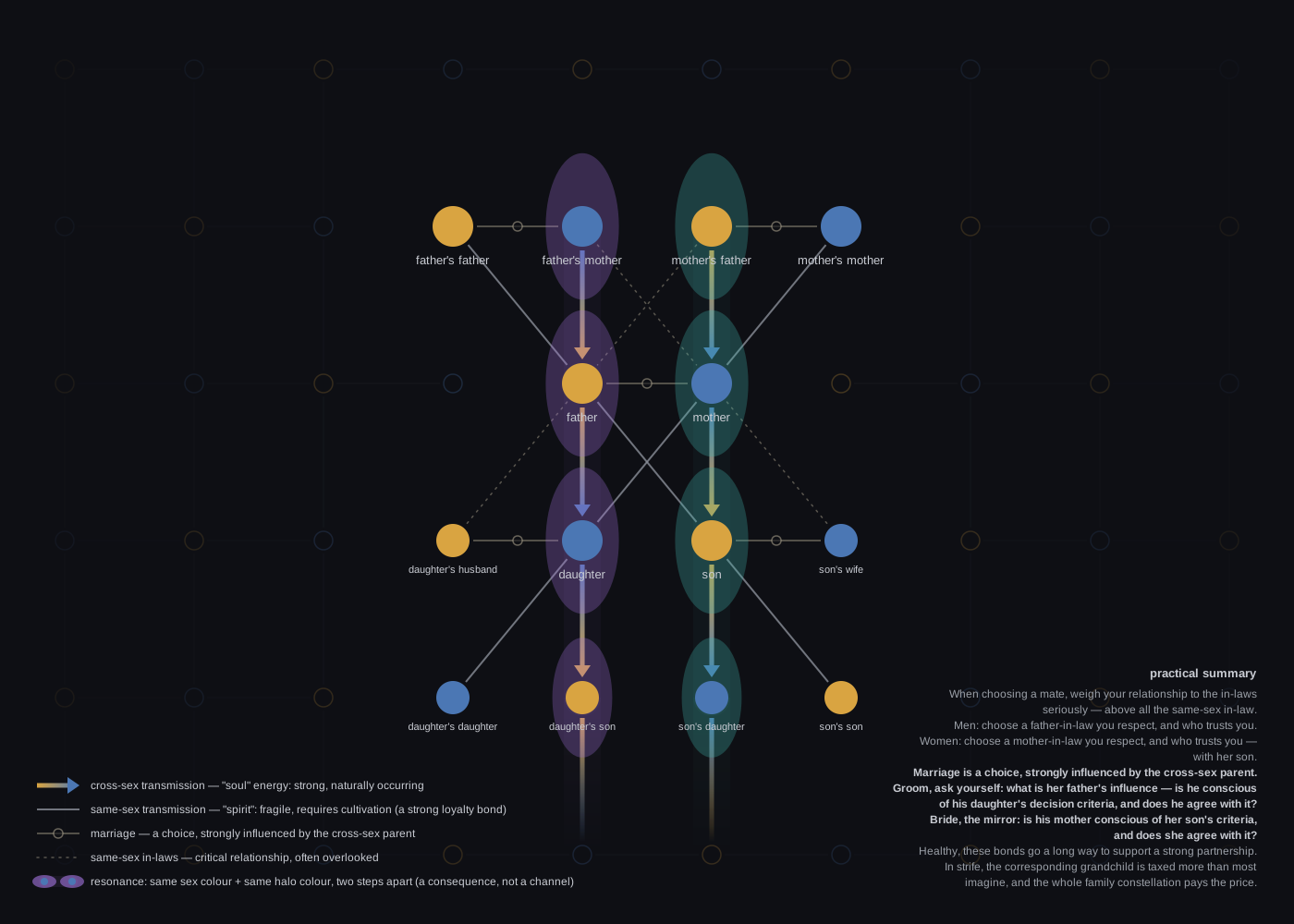
Harmony state. The two coloured vertical currents are the two criss-cross lines. Halos mark the resonance between grandparent and grandchild that appears when the line is conducting cleanly and the elders on that line are at peace.
When the line breaks
The catalog's most consistent negative finding is not that the line stops carrying, but that it stops carrying when the two older people on it are at war. The classic staging is three generations under one roof, in-laws in open conflict; the grandchild grows up in that strife, and the effect on the child is not neutral.
The pattern that repeats: the child stays close to the parent through childhood — a forced loyalty — and then, at puberty or on leaving home, turns hard against that same parent. The grandparent-shaped piece of the self was denied for years to keep the loyalty. When distance finally allows it to surface, the rupture with the parent is the shape of the surfacing.
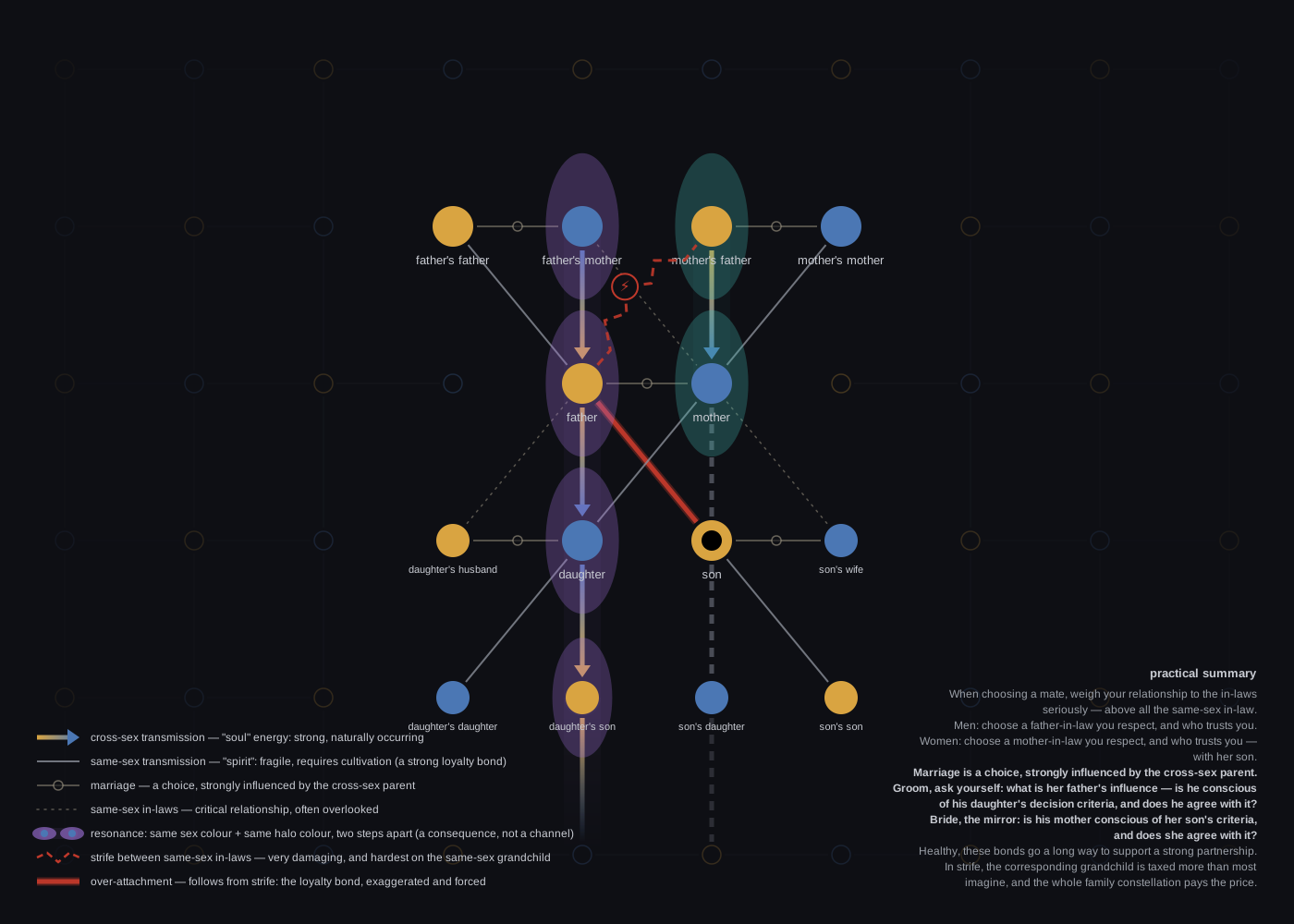
Strife state. Father and maternal grandfather at war (jagged red). The mother-to-son segment goes dark and dashed — the path is present but not conducting. The son loses his halo; a dark inner core takes its place. The block propagates downstream to the next generation.
How the transmission actually works
The two lines carry different content in different ways. The cross-sex channel — mother to son, father to daughter, and the skip to the same-sex grandparent — transmits essence passively: wavelength, temperament, affinity. It runs even if the grandparent died before the grandchild was born, provided the mother keeps the story alive. The same-sex channel — father to son, mother to daughter — transmits craft actively: trade, discipline, family style. It has to be built, over years, by a present and engaged same-sex parent. If the father is absent, competent parts of the son's craft simply don't get taught.
The essence channel has two phases. Phase 1 is the birth-set wavelength — already there in the child's constitution. Phase 2 is what turns the seed into an identity: unencumbered engagement with the grandparent-figure through childhood, in person or in family legend. Phase 2 is where the strife pattern does its damage. When the parent on the block-line negates, ridicules, or punishes any child behaviour that "smells of" the disliked grandparent, the child learns to disown those parts of themselves — unconsciously, by roughly age six to ten. The buried piece surfaces at puberty or leaving home, often as a rupture with the living parent whose approval bought the burial in the first place.
The spine
Ten lines that hold the whole schema. Compressed from §13 of the working document.
- Always across sex. Mother → son. Father → daughter. No mother–daughter resemblance line in this catalog.
- It skips. The landing is the same-sex grandparent reached through the cross-sex parent: mother's father for boys, father's mother for girls. The crossing is at the parent generation.
- Wavelength is the intimate track. Daddy's girl and mommy's boy train later pairing. People marry a tuning they already know.
- Spirit is the same-sex track. Father–son and mother–daughter teach group life and discipline.
- The opposite-sex grandparent who is same-sex as the child is the double source. Maternal grandfather for the boy: spirit and wavelength. Paternal grandmother for the girl, by symmetry.
- That grandparent is a living mirror. Same sex, further along in time. Identity becomes visible.
- Harmony on the line lets the mirror work. The farm case: grandfather and son-in-law at peace; boys become strong.
- Strife on the line forces a loyalty choice. Child picks the parent, denies the grandparent-shaped essence, then turns on the parent at puberty or leaving home.
- Hatred often aims at the living parent because the grandparent is gone. The parent is the reachable target, not always the original author of the block.
- Over generations this is a dance between the sexes, not a one-way dump of traits.
What it says to a person alive today
Most of the schema is descriptive. One consequence is not — it concerns a decision people actually make.
Choose a mate weighing the same-sex in-law relationship. Strife there taxes the same-sex grandchild heavily.
That sentence is where the diagram earns its keep. The usual marriage advice is about the partner. This is advice about the elder on the far side of the partner — the person the grandchild will need as a living mirror, and the person a bad in-law relationship makes into a battleground. It is a claim the reader can act on before it becomes a story about their child.
Testing the shape
The observations came from one road, one family, and a decade of interviews. That is not a corpus. Three parallel workstreams are building evidence, each targeting a different failure mode of the single-witness argument.
Machine-scale scans
Gutenberg scan. Four-stage pipeline over the ~62,000-title English Project Gutenberg corpus. Every passage describing resemblance, affinity, or trait transmission between a person and a grandparent or cross-sex parent is extracted, double-classified (Haiku sieve → Sonnet judge), and quote-verified against the source text — hits that can't be quoted verbatim are auto-rejected. Anti-fabrication first, coverage second.
Pilot on 500 randomly sampled books completed September 2026: 1,167 extracts → 657 sieve positives → 170 confirmed claims, ~2% quote-fail (well under the 5% alarm line). Six full three-generation criss-cross configurations surfaced, including Lycophron (via Herodotus in Lodge's Best of the World's Classics) instantiating the entire strife diagram in one classical source. On the twelve hits where both the in-law axis and a child outcome were stated, the harmony/strife × fortunate/blighted crosstab came out perfectly diagonal in the schema's direction. At n=12 that is an anecdote with a table around it; the full run projects ~21,000 confirmed hits.
Cinema register scan. Vocative-address dyad detection on the Cornell Movie-Dialogs Corpus (617 films, 9k characters, 305k utterances) and IMSDb screenplay dump (1,095 modern films). For every identified parent–child dyad, the dialogue is scored for emotional-vocabulary density. In Cornell, cross-sex parent–child dialogue carries ~19 % denser emotional vocabulary per word than same-sex; ordering is monotone, father–daughter highest, father–son lowest. The IMSDb replication does not cleanly reproduce (cross-sex ~ same-sex on emo density; mother–daughter unexpectedly leads), documented honestly — the pipeline has more noise, and the modern corpus may reflect a genuine register shift in how mother–daughter dialogue is written.
Case studies
Buddenbrooks (Mann, 1901). Close reading of Mann's four-generation family chronicle. The novel builds its entire arc on the schema's cross-sex 3-generation chain: Herr Arnoldsen (violinist merchant, maternal grandfather) → Gerda Buddenbrook (violinist) → Hanno (musical, unfit for the paternal firm). In Mann's text the father Thomas asks the schema's own question — "did he, after all, belong entirely to the mother's side?" — and the novel's title, Verfall einer Familie, is the answer seen from the losing paternal line.
Elon Musk (public figure). Live case where the schema shape is now attested from both sides of the disputed line. Elon's essential public identity — aerospace, serial emigration, contrarian populism, extreme personal risk — matches his maternal grandfather Joshua Haldeman trait-for-trait, not his father Errol. Errol's own on-the-record account in Michael Vlismas's authorised 2023 biography confirms the strife on the line ("forever at loggerheads with Maye's parents", engagement broken 1968), dated to before Elon's birth, in the father's own voice.
- Schema
- Catalogued and stable. Last major revision September 2026 (§9.5, mechanism).
- Diagrams
- Harmony and strife lattices generated from code.
- Gutenberg pilot
- Complete on 500 books. 170 confirmed claims, 6 full 3-gen configurations, diagonal-in-schema-direction crosstab at n=12. Full-corpus decision open.
- Cinema scan
- Cornell (617 films) shows 19 % cross-sex emo-density lift. IMSDb (1,095 films) does not cleanly replicate. Both documented.
- Case studies
- Buddenbrooks and Musk written up. Three additional canonical novels analysed as counter-tradition evidence.
- Known bias
- Pre-1929, Anglo-American, literate, overwhelmingly male subjects in Gutenberg. The paternal-grandmother / granddaughter crossing will be under-represented in the sources. Recorded, not fixed.
Not a claim
This project is a working document. It began as a road-side conversation about milk cows and their bull calves, and grew into a catalog only because the same shape kept turning up in family histories, interviews, and public lives. It is not Mendelian genetics as a full explanation. It is not a claim that every family displays the pattern equally, or that environment, culture, and chance do not matter. It is a catalog of the shape as lived, filed by whether the older pair on the line was at peace or at war.
The filing rule for new stories, in the source document's own words: do not force a mechanism. If a new story breaks the "always across sex" rule, record the break instead of sanding it off.